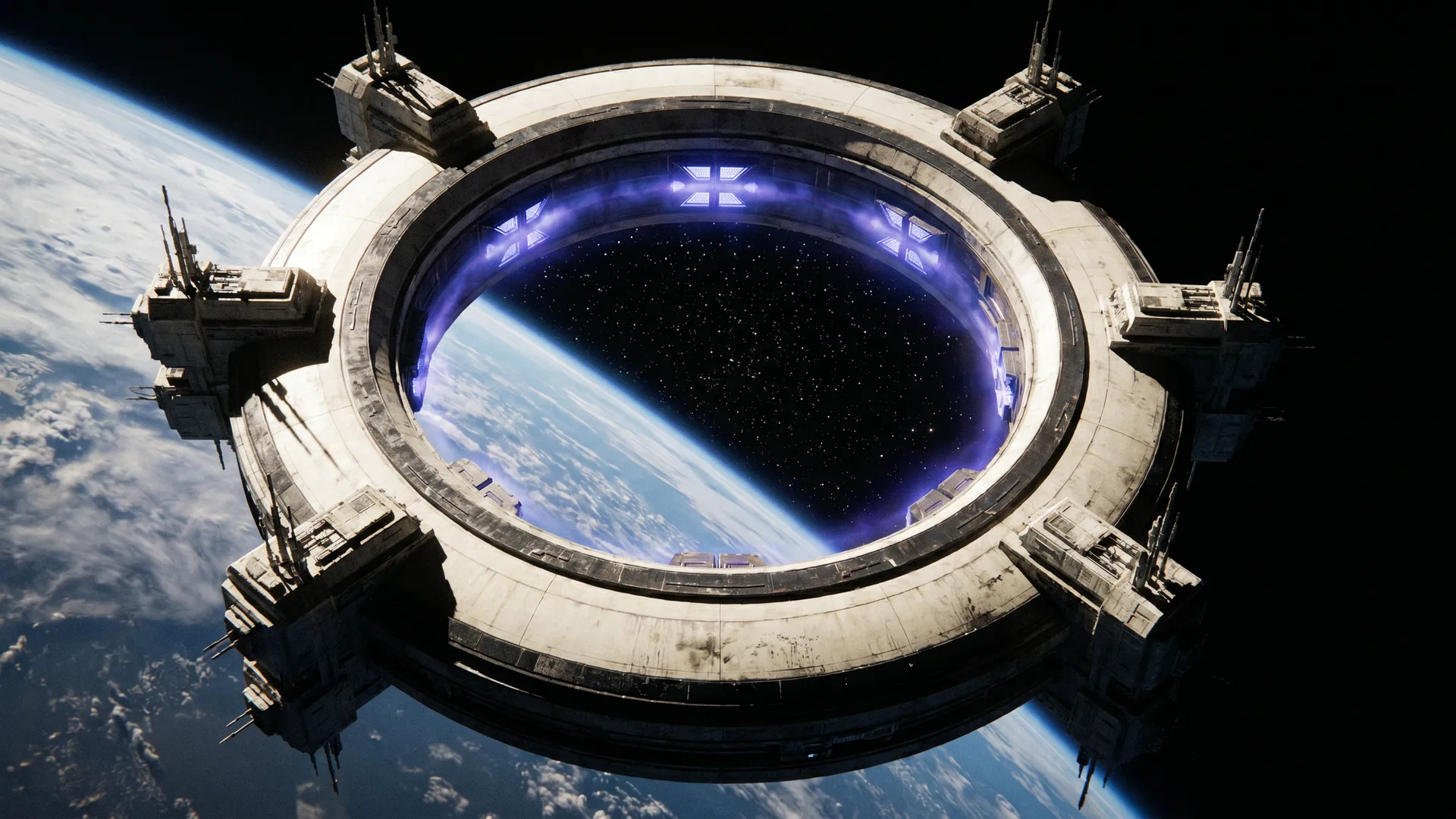
THE VELANTHRA GATE — EG-1
The door the universe
always had.
Earth to Aethon Prime. Sixty thousand light-years. Eleven days.
2955. Jodrell Bank.
Two worlds. Nobody could reach them.
In 2955, Jodrell Bank Observatory — processing deep sky survey data on Alpha Systems compute twelve miles away in Alsager, Cheshire — identified a star system sixty thousand light-years away. Two worlds. Atmospheric signatures consistent with habitability.
They named the system Velanthra. They named the worlds Aethon Prime and Harven.
The astrophysics community was excited and then moved on. The physics community noted it and filed it under extraordinary but unreachable. Sixty thousand light-years. The nearest star is four. Nobody had a framework for the distance involved, let alone the means to cross it.
One person asked a different question.
Not: how do you travel sixty thousand light-years? But: is distance the right frame for the problem at all?
His name was Yuen Fang-Li. He was seventeen years old. He was choosing his university course. He chose Manchester because it was the closest university to Jodrell Bank. He stayed for fifty-four years.
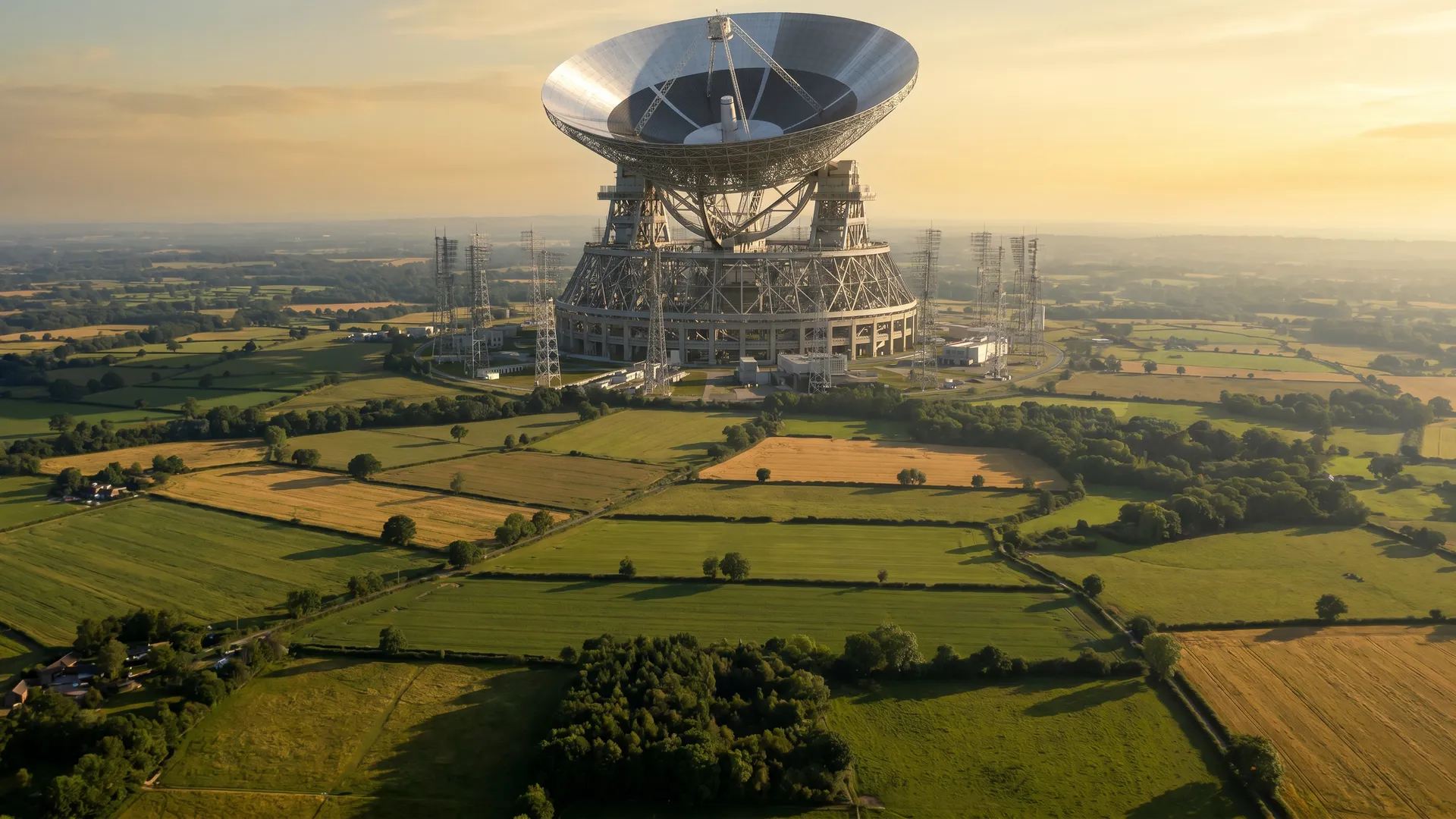
JODRELL BANK — ALSAGER, CHESHIRE — THE TELESCOPE THAT FOUND VELANTHRA
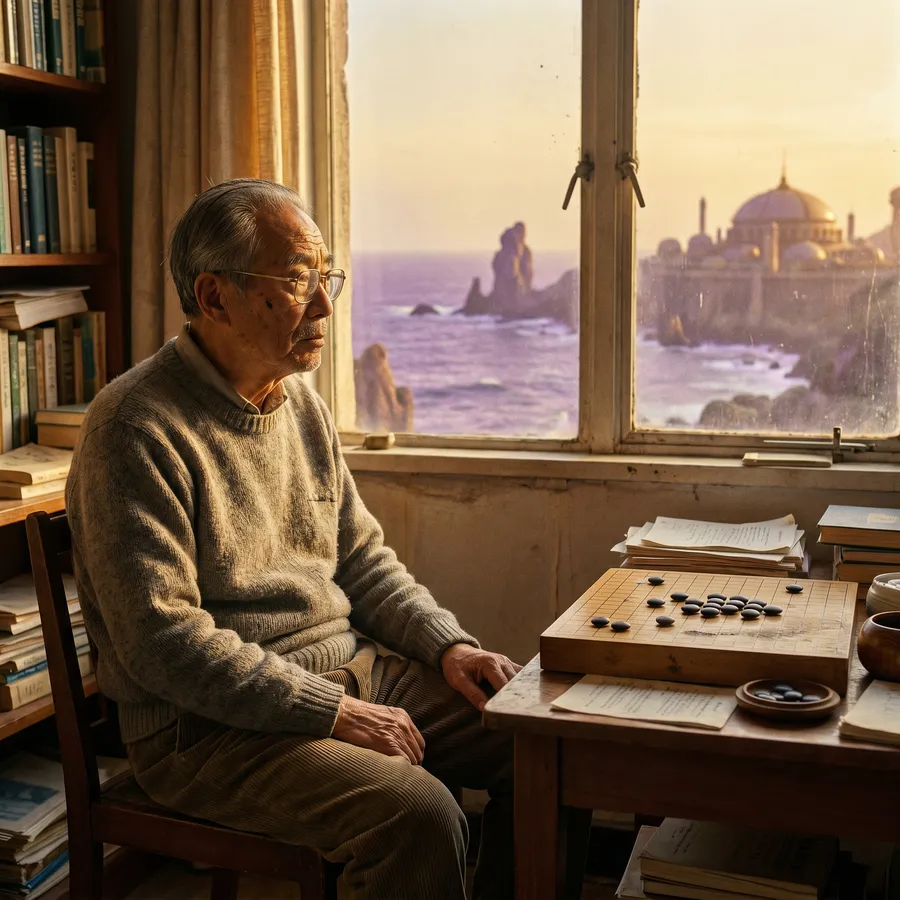
DR YUEN FANG-LI — AGE 89 — FACULTY QUARTER, SOLACE CITY
Dr Yuen Fang-Li.
The equations that changed everything.
In 2980, Fang-Li published a twenty-seven page paper in Physical Review D. The physics community called it mathematically elegant and almost certainly impractical. They were wrong about the second part.
The paper proposed that spacetime topology — under specific energy conditions — was not a mathematical curiosity but an engineering material. That the fabric of space could be threaded: not bent, but precisely channelled via a stationary orbital installation generating a sustained, calibrated energy field.
The mathematics identified one stable traversable path from low Earth orbit at the required energy parameters. It led to the Velanthra system. Alpha Horizon didn't choose the destination. The equations found it. The paper did not describe how to build the installation. It described, with mathematical precision, why one could exist.
Buried in the same paper, in Appendix D, was something Fang-Li had spent two weeks trying to disprove. He had checked it every way he knew how. It did not change.
Anyone who crosses is staying. The biological transition is irreversible. The physics does not offer a return.
He published it anyway. Thirty years later, he was one of the first hundred through.
"I needed to know if I was right. I could not send a hundred people through my equations without being one of them." — Fang-Li, 3010
Alpha Horizon. The company that was going to build it whether the world was ready or not.
In 2938, Robert Voss founded Alpha Systems Ltd in Alsager, Cheshire. His insight was simple and contrarian: the companies that would own the next century weren't going to be the ones with the best researchers. They were going to be the ones with the most reliable compute. He built it. He went first.
His daughter Helena grew up in the building. When she took over in the late 2970s, she found Fang-Li's Gate Theory simulations running on her father's hardware. She read the results. She contacted Fang-Li directly. They met four times before his paper was published.
In 2980, at Alpha Systems' formal Gate programme launch, Helena Voss committed the company to the Gate. It was the most consequential strategic decision the company would ever make. She did not live to see the first transit.
She died in 2996. Suddenly.
Jonathan Hargreaves was thirty-three years old. He had been at Alpha Systems since his mid-twenties — the engineer who had read Fang-Li's paper at seventeen and understood it; the one who had championed the Manchester research contract; the one who had been making the internal case for the Gate for a decade. Helena had been his CEO, his mentor, and the person who had turned the theory into a programme. When she died, he became CEO of a company forty-two years into a project that had not yet sent a single probe.
He renamed the company Alpha Horizon.
"The horizon is not a destination. It is a direction."
KEY DATES — ALPHA HORIZON
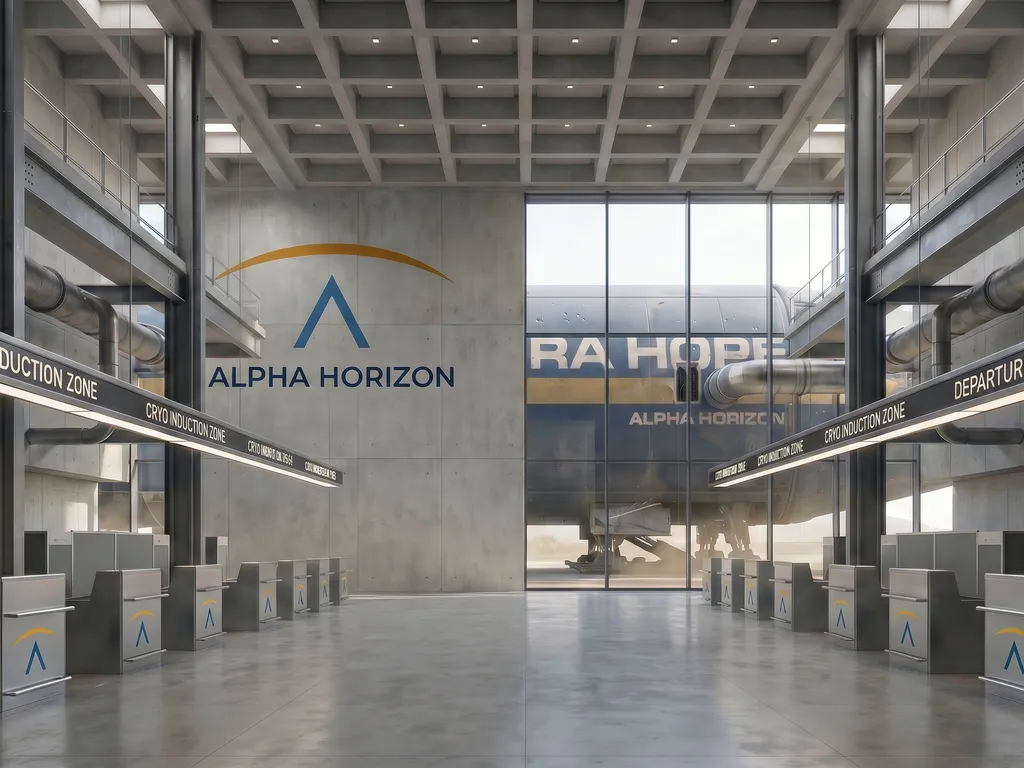
THE THRESHOLD — ALSAGER, CHESHIRE — THE LAST BUILDING ON EARTH
Thirty-five years. Two failed probes. Two years of silence.
Construction began in 2986. The peak workforce reached 34,000 people. The ring itself — 2.1 kilometres in diameter, pale composite and dark alloy — was assembled in orbit above Alsager, directly above Alpha Horizon's ground control facility. It runs on a Coreum Energy onboard reactor. It has never been switched off.
The first probe attempt, 2998, lasted 0.3 seconds before the threading field collapsed. The probe did not return. The second probe, 2999, survived eleven seconds inside the Corridor before telemetry cut. Also lost.
On 12 April 3000, the third probe — VP-3, designation Vanguard — transited the Gate and emerged in open orbital space above Aethon Prime. It deployed its relay. Then it waited.
Earth waited with it.
For two years, the Gate team continued building. Alpha Horizon said nothing publicly. The probe was either transmitting from sixty thousand light-years away, or it was not. There was no third option and no way to know which it was until the signal, if there was one, made its way back through the Corridor.
In early 3002, the probe's signal came through. Position confirmed: Velanthra system. Aethon Prime atmospheric data within human survivable range. Theory correct.
The team was told on a Tuesday morning. Most of them had been working on the Gate for over a decade. Several of them had been working on it for twenty years. They received the news. They went back to work.
17 March 3010.
The Hundred.
On 17 March 3010, one hundred volunteers stepped aboard ISV Vanguard at The Threshold in Alsager, Cheshire. They had been selected by a process that took three years. They included engineers, physicians, agronomists, architects, geologists, and a linguist. They were the people a new world needed first.
One of them was seventy-three-year-old Yuen Fang-Li.
Every one of them had read Appendix D. Every one of them understood the physics of what they were doing. The transit was one-directional — not a policy decision, not a commercial restriction. Biology. The threading field that carried them through the Corridor made a change at the quantum level that could not be undone by going back. They all knew. They all crossed.
The transit took forty seconds in the Gate aperture. Then most of a day in the Corridor, passengers awake and watching every hour of it.
On the other side: Aethon Prime, exactly where the mathematics placed it. The probe had been waiting there for twelve years, still transmitting, still patient. Dr Fatima Al-Hassan identified it on approach. They went to it before they went anywhere else.
"The planet is extraordinary. The light is the colour of late afternoon, all day, everywhere. The sea bioluminesces at night — blue-green, deep and steady, like the planet breathing. I stood on the surface for four minutes before I remembered that I was supposed to be collecting soil samples."
— DR YUEN FANG-LI, UNIVERSITY OF VELANTHRA LECTURE, 3023
They called themselves the Founding Generation. History has called them The Hundred. Between 3010 and 3014, twelve Vanguard-class ships carried 6,100 people and everything needed to build a world. When the Pioneer Programme opened at scale in 3021, there was already a city waiting for you.
When the programme opened in 3021, there was already a city waiting.
397,000 people have crossed. The ships are still leaving. Find out how to be on one.